Sunday, April 3, 2011

“Ancient Black Coral in the Gulf of Mexico”

According to Andy Soos, of the Environmental News Network, most recently, scientists have finally been able to discover the age of the deep-sea black coral population in the Gulf of Mexico. These 2,000 year-old animals growing approximately 8 to 2 micrometers per year (200 times slower than human fingernails) are critical to understanding environmental change. Scientists can use these black corals as “natural archives” through age dating to peer into an “unprecedented window into past environmental conditions.” Besides being able to provide this enlightening data to scientists and researches, the black coral ecosystems are important for other reasons such as being “among the most diverse and productive communities on Earth, providing shelter and feeding grounds for commercial and non-commercial fish species and their prey, as well as breeding and nursery areas.” These creatures are also highly sensitive in the fact that even though they live over 980 feet under water, they rely on what is happening at the seas surface because they feed on the organic matter that sinks down to the ocean floor. Both environmental changes as well as human factors such as commercial fishing, can impact these ecosystems.

This article relates to our class in many different areas. 1) It addresses the population growth of one of the most diverse ecosystems on the planet. 2) The article touches upon how events in the natural world are all interconnected. For example, if fishermen start to catch the fish that normally reside in these coral reefs, these reefs will without a doubt be affected. 3) In class we also discussed coral reefs in a little more detail learning that thousands of different species live among them, specifically, 25% of marine species live in these systems, and that temperature, light, and salinity all effect coral reef growth and survival.

What I liked most about this article was how I learned that this special type of coral that lives deep below the surface of the ocean is a gateway to a better understanding of the environment and its changes over decades. Also, it was interesting to learn how new techniques such as “sampling skeletal material with a laser can determine its chemical composition, enabling scientists to reconstruct environmental conditions in time slices smaller than a decade over the last 1,000 to 2,000 years.” This innovative technology and others like it, will continue to aid researchers, scientists, and ultimately us, in understanding the complexities and intricacies of the environment in which we live.

Blog By: Kaitlyn McHugh

Article & picture source: Andy Soos, Environmental News Network – April 1, 2011

http://www.enn.com/wildlife/article/42539

The Importance of Bats to the United States Economy

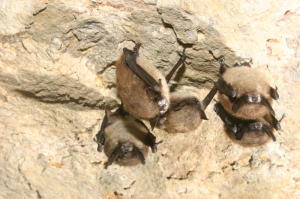
Would you think that bats, small flying mammals, have a large impact on our country's financial well-being? Well, its true. Two factors are having an enormous impact on the lives of bats in the United States- wind turbines and White Nose Syndrome. The picture to the right shows five Little Brown Bats infected with White Nose Syndrome.
Although it is unknown how many bats have been killed by wind turbines, some scientists estimate that by 2020 wind turbines may kill 33,000 to 111,000 annually in the only the Mid-Atlantic Highlands. If this estimate is accurate and is true of other places that house wind turbines, we may lose countless bats in North America.
White Nose Syndrome is an infection of the skin that begins while a bat hibernates. It is a fast spreading disease that has already quickly made its way from Canada to Tennessee, Oklahoma, and Missouri, and without prevention or successful attempts at containing and ceasing the spread of this infection may result in extinction of some native North American bats (such as the Little Brown Bat pictured above).
How serious is the impact of White Nose Syndrome? In one word- devastating. We as Americans rely heavily on bats to consume many of the pests and insects that would typically damage and kill our agriculture. "In fact, the researchers estimate the value of bats to the agricultural industry is roughly $22.9 billion a year, with the extremes ranging as low as $3.7 and $53 billion a year." (Science Daily) It is obvious that we as avid consumers of plants, vegetables, and other agriculture need to do something to stop this infection from spreading onto new colonies of bats. Researchers are currently urging policy-makers to do something about this atrocity now because waiting the problem out may prove costly.
This problem, relating bats in North America to the United States economy exhibits one of the largest principles of ecology: interconnectedness. Every animal, every plant, every organism, and every environment are all interconnected. The actions of one organism (or many) has an impact on something and many things within its environment. It is so interesting that one species of bats has such an economic impact on the daily lives of Americans. This further proves that our interests as humans are always being impacted by the interests of other animals and organisms. It is up to us, as the leading and most superior organism on the planet to protect all others, for now we should know that one little bat may have a large impact on our daily lives. By protecting the organisms that surround us daily, we are in return protecting ourselves.

Photo Credit: Al Hicks, USGS
Article: Science Daily, April 1st, 2011:

Economic Importance of Bats in the 'Billions a Year' Range

Saturday, April 2, 2011

Global Warming is No Laughing Matter


Everyone has heard of the idea that global temperatures are increasing, however many believe this to be a myth. With the cold weather and harsh winter many in the United States have endured, you would think that global warming is indeed only a fabrication. People actually use the cold weather as a sign that Earth’s climate is indeed not warming. I know I fall victim to this very idea that global warming is not a true problem. Looking only at the United States, who would believe in global warming, when below freezing temperatures are so common in the winter. However, you must look at the bigger picture and take into consideration areas all over the world. For example, this year alone, Canada has had a significant decrease in the amount of snow that is typical for the area. Also, certain parts of the Arctic have had temperatures rising to as much as twenty degrees above normal.

Last year, in 2010, it was recorded as the hottest year since 1880, tying with 2005 as the warmest. Because of these warm temperatures, this year was also recorded as one of the wettest. The warming of Earth’s atmosphere causes an increase in evaporation, causing more water vapor to form which in turn increases the amount of precipitation. The warm surface area causes the air to warm, which causes it the rise because it is less dense, which as a result, cools as it rises eventually forming clouds. We are increasing the amount of greenhouse gasses which is altering the energy balance of the Earth, changing the climate system. According to climatologists, severe weather can also occur, causing extreme storms and floods or extreme droughts. Excessive snowfall can also be a result, which is the case with the United States.

Humans are the very cause of this problem. The increase in the amount of carbon dioxide entering Earth’s atmosphere from the use of machinery, amongst many other things, is a very big contributing factor to global warming. Carbon dioxide levels are growing at an alarming rate, and a change needs to be made. We must reduce our carbon dioxide emissions if we want to avoid potential disastrous weather.


Source: http://www.lohud.com/apps/pbcs.dll/article?AID=2011102130333


Tick Population Plummets in Absence of Lizard Hosts


Researchers at the University of California, Berkeley, recently conducted a study to determine what the effect would be on juvenile Lyme infected ticks when their host, the Western fence lizard, was removed from their habitat. The Western fence lizard is known for its ability to reduce the threat of Lyme disease. The results of the study were quite surprising, not what the researchers had expected. One of the lead researchers Andrea Swei thought the removal of lizards would increase the risk of Lyme disease, which in turn, caused a decrease in the risk of Lyme disease in humans.

In an earlier study that was conducted in 1998, it was discovered that the Lyme infected ticks who fed on the Western fence lizard's blood were eradicated of the disease. The lizard's blood was actually killing the bacteria in ticks that caused Lyme disease. The Western fence lizards have been credited with the low levels of Lyme disease in many parts of the United States.

This recent study, conducted prior to the 2008 tick season, had researchers capturing and removing 447 lizards from 6 to 14 plots in two designated areas in California. The remaining 8 plots were used as control. For the next few months, researchers trapped other potential tick hosts, such as the woodrat and deer mouse, to see if they hosted more ticks than usual as a result of the removal of the lizards. Researchers discovered that 95% pf ticks who could not feed on the Western fence lizard's blood preferred no other host.

This study would suggest that the role of the lizards in reducing the risk of Lyme disease is quite significant, but it must be pointed out that the study focused on juvenile ticks only. What the results would be on adult ticks is uncertain but it is known that there is already a lower infection rate for adult ticks because of their earlier feasting on the lizard's blood. So what is the more effective way to reduce the threat of Lyme disease- remove the Western fence lizard's who are known for their ability to reduce infection in ticks or increase their population so there are more hosts for the ticks to feed on?


Source: http://www.sciencedaily.com/releases/2011/02/110215191631.htm

Wednesday, March 30, 2011

Are expanding forests here to stay?

https://blogger.googleusercontent.com/img/b/R29vZ2xl/AVvXsEi8AJACr1PMMJwXwprEwln8mraMGEXoz-lE864VRP1MpzuUCRyZO8pwOlU-nvmcIC84w5EKJeq-qIIqc7AaO6UDQ7LTjW0obl6vY5fUoCDXASo1OCEyQwHe1_9vpT5Z8ef1JrLMCbMJbiie/s1600/f-temperate.jpg
Over the past century, there has been a drastic increase in the logging industry. This increase has resulted in many forests being completely demolished in order to harvest the logs for buildings and commercial projects, as well as for allowing for more land that can be used for agriculture. However, on March 23, 2011 there was a very interesting story published on the Environmental News Network that shows forests in the Northern Latitudes are actually expanding. The Northern Latitudes include North America, Europe, Central Asia and the Caucasus. In the past 20 years, it has been determined that these forests have grown by 25 million hectares. To put that into perspective, a hectare is just shy of two football fields in size. One of the main reasons why researchers have seen this increase in forests is due largely to the conservation efforts of the surrounding countries. There has been more land dedicated back to forests, and they have been properly taken care for and maintained.

http://www.enn.com/ecosystems/article/42501
This is such an important issue because these forests play a huge role in the daily carbon cycle of our world. These trees act as a repository for carbon dioxide, which helps to improve the air quality. With the increase in forest size, there is an increase in the number of trees that take part converting the carbon dioxide to oxygen. There is however, one issue standing in the way of these forests, and that is climate change. Researchers have warned that due to the increasing variability of the climate, the trees may not see this positive growth in the future. An example is that the mountain pine beetle in North America has devastated over 11 million hectares of forest since the 1990’s due to the warmer climate in the winters.

This topic relates to almost everything we have been talking about in class. Ecology is the study of how the environment and organisms interact with each other. This article is a study of how climate change has drastically affected forests all over the world. The climate change has allowed species like the mountain pine beetle to thrive in the forest while devastating it at the same time. In on of the case studies, we looked at how the introduction of a jelly fish to the Black Sea allowed it to thrive but, devastated the rest of the environment around it. The environment is affecting how the forests grow or shrink around the world, and the forests are affecting the environment by being a major player in the respiratory system.

http://www.permaculture.org.au/images/rain_forest.jpg

This is a very important issue that the world needs to take seriously. The forests have grown by 25 million hectares in the last 20 years but, due to the increasing climate change, one mountain pine beetle can destroy over 11 million hectares in 20 years. There have been some major strides taken to improve the forest with World Forest Day, and more forest conservation but, there are so many other things that can be done to help. The World Future Council is trying to help sponsor the International Policy Award for Visionary Forest Policies in order to increase the number of expanding forests. I believe that people need to become more aware of the environment changing around them and really look at the drastic changes that are happening. We have made a lot of progress helping the forests that we have destroyed re-grow, and now we may loose them again. I don’t have a solution to help these forests but, I do think that increasing the amount of policies that help protect them and increasing research will drastically help. Anyone that has ever been to a forest knows its beauty and significance to the world, we can not loose anymore of them. The forests must be protected from further destruction and deterioration.

Source: Environmental News Network, March 23, 2011

http://www.enn.com/ecosystems/article/42501

Where's the Fish?


Fish are a critical part of the human diet because they have a great deal of protein. However you might have realized that the amount of fish in fisheries across the world has been on a steady decline. Currently there are about 80 million metric tons of fish made availible across the world per year. According to http://www.wri.org/publication/content/8385. This might seem like a very large number to the point of there being plenty of fish to eat but it is not. In reality this has been on a slow decline over the past few years while the global population has been on the steady incline. So with one going upward and the other going down eventually there will be a shortage of fish to eat. This shprtage would affect the developing weak countries before it will bother any established one because the weaker countries need the fish in the ocean to survive while the stronger ones have many other options to eat and get their protein.


This relates to our course because we had an entire case study on how the Atlantic Cod is being overfished and run to extinction. To control this they put on a limit on the size of the fish they can keep along with the amount of fish each boat can catch over a set period of time. In the long run limiting the number of fish they can catch will help repopulate the Atlantic Cod population it is also limiting the number of fish that can be eaten by the humans on this planet.


My view on this subject is that people just need to be smarter in how they live. For example 80 million metric tons of fish are made available each year but i doubt that every last fish is eaten. I feel like there are a lot of people over buying fish when they go to the store. This causes the fishermen to try to catch more fish because in business you never want to run out of your product. So by people buying more than they will eat it forces the companies to catch more fish than they want to catch. And that is the cause of overfishing across the world.


Andrew Whyte

Thursday, March 24, 2011

Endangered


The extinction vortex of a species can best be defined as a pattern in which a population falls below a certain size just may decreased even more in size and eventually ends in wiping out the entire species. This is the path that endangered North Atlantic Right Whale's will be heading if researchers cannot figure out what exactly is going on with the mothers. To date, there are only about 300 whales left as a result of the high mortality rates that are faced by almost all of its female population. The declination of mothers is a very serious issue, if all mothers were to die out, it will only be a matter of time until the rest of the surviving members of the species do so as well. Through studies and research, the species is expected to become extinct within about the next 200 years unless prevention measures can be discovered and acted out. Scientists at the Woods Hole Oceanographic Institution narrowed down the causes of death in the population to: (1) entanglement in fishing gear; (2) ship collisions; and (3) limited food sources due to climate change. If changes within fishing systems, locations and a limit on what kinds of fish and how many are caught were to be enforced, it can make a considerable difference. These will make it possible to protect the North Atlantic Right whales from extinction or at least stabilize the current population. It is still unsure why female whales are dying in such ways. Some researchers have said that after giving birth, they reside in shallow waters where it is very likely that they come in contact with a ship or fisherman and do not realize what exactly it is or what they are doing until the last minute. This endangered species deserves to live just as much as every other species. We need to step up and work to fix these issues, for it seems the whales cannot do it on their own.
Ecology is the study of the interactions between organisms and the environment in which they live in. Organisms come in all shapes and sizes, as well as with different backgrounds. The North Atlantic Right whales are organisms that fall under the category of an endangered species. This is a very serious topic for researchers work to figure out what exactly is causing populations of species that were once abundant and flourishing to decline at rapid rates. So far, it has been discovered that part of the reason as to why these whales are lowering in numbers is that they have been colliding with humans. If humans were not around in the areas in which the whales inhabit, it's said that they would not be suffering such a drastic loss. They would not be on the endangered species list and they would be multiplying and surviving, rather than reproducing, and the mother dying off a short time later.

This is such a sad issue that I'm pretty interested in. I find it fascinating that a species that at one time had a surplus of individuals and decades later, they are dying off. It's almost a mystery. The problem is species falling under the category of being endangered and we need to figure out why this is happening. It's sad that because of human interactions with the environment that we are causing the lives of sea creatures to come to an end. I believe that we need to become more vocal and be strict about where and when fisherman can be with their ships and gear, for if it weren't for their activities, these whales would not be in such a dilemma.